
Published in the Fall 2026 Quarterly Newsletter
Making operational decisions in campus health without reliable peer data often leaves leaders managing without a true reference point. Accurate, standardized benchmarking bridges that gap—giving administrators the objective evidence needed to evaluate services, optimize staffing models, and advocate effectively for university support.
To demonstrate how higher education health leaders put these metrics to work in real time, we spoke with two campus leaders: Felix F. Pizzi, MSEd, LCMHC, CCMHC, Assistant Vice President for Student Health and Well-Being at Southern New Hampshire University, and Meredith Hayden, MD, Chief Medical Officer for Student Health and Wellness at the University of Virginia.
Below, they share practical ways their institutions leverage ACHA’s Data Hub—from comparing EHR vendors and health requirements to justifying budget requests and protecting student services. Discover how tapping into higher education’s collective data can help your campus move from intuition to data-driven advocacy.
Q: What originally prompted you to log into the Data Hub?
Meredith: I was interested initially in determining clinical staffing and clinic utilization as compared to our peers. I am currently focusing on health center integration, and I was very intrigued by the statistics available in the Data Hub that are pertinent to this topic.
Q: Before utilizing the ACHA Data Hub, what challenges did you face when trying to prove the value of your services to institutional leadership?
Felix: Before the Data Hub, we had limited visibility into what other institutions were doing or how their services were performing across their student populations. Information about immunization compliance and other health requirements was also harder to find. That made it difficult to show leadership how our services compared with peer institutions and why certain policies or resources might be needed.
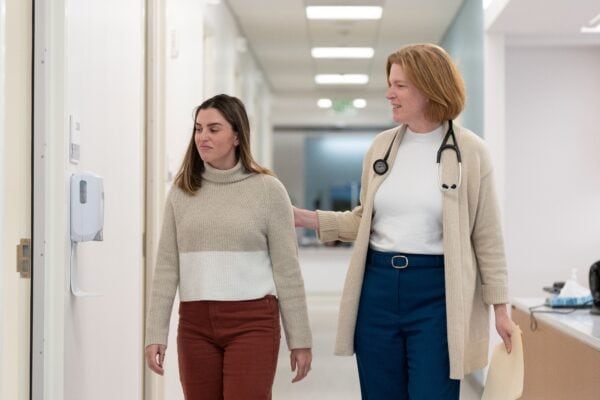
As the Chief Medical Officer for the University of Virginia’s Department of Student Health and Wellness, Dr. Hayden (right) provides strategic and clinical leadership for comprehensive health services. She also maintains an active clinical practice as a staff physician.
Q: Can you describe a time you were working on something and you thought, “Let me check the ACHA Data Hub for that”?
Meredith: Recently, our team has been reviewing EMR vendor types, particularly for integrated health centers. I was able to utilize the Data Hub to determine which EMRs different schools are using.
Q: Why is standard benchmarking data so critical when advocating for student health and well-being programs?
Felix: College health and well-being is a unique part of the healthcare world. We are trained as clinicians and healthcare professionals, but working in higher education brings a distinct set of needs and expectations. Learning what is common—and what is considered best practice—can therefore be both important and challenging. Standard benchmarking gives us comparison points that are specific to college health, rather than relying on broader healthcare benchmarks that may not reflect the campus environment.
Q: How did a lack of centralized data prior to your access to the Data Hub impact your ability to connect health services directly to student metrics like persistence and retention?
Felix: Before the Data Hub, there was a gap in both knowledge and transparency. We did not have an easy way to place our services within the broader higher education context or determine whether what an institution was providing was typical or outside what could reasonably be expected.
Q: How does having a massive data pool from over 200 schools elevate ACHA’s role as a trusted partner for your campus?
Meredith: Counseling center directors are fortunate to have access to other benchmarking through the AUCCCD. I have found that the ACHA Data Hub gets primary care/medical directors closer to some of that information needed to lead large teams and administer services. Additionally, knowing the percent of schools offering different services is very helpful in strategic planning.
Felix: Having access to a data pool of that size reinforces ACHA’s role not only as a trusted partner in helping colleges and universities better meet their needs, but also as a centralized source of expertise and best practices in college health and well-being.
Q: How has access to the Data Hub changed the way you position your department during budget or staffing discussions with school administrators?

As Assistant Vice President for Student Health and Well-Being at Southern New Hampshire University, Felix Pizzi oversees health and well-being services for 3,000 campus students and digital wellness and mental health resources supporting more than 200,000 online learners.
Felix: The primary impact has been the ability to establish a baseline for the services institutions of higher education provide. Rather than looking at our university’s services in isolation, we can place them within the broader higher education landscape. That context helps educate administrators and gives us evidence-based guidance on how to best serve our student population.
Q: Can you share how improving or protecting your services using this data ultimately impacts the day-to-day success and well-being of your students?
Felix: The data gives us a baseline for the services we provide and shows that our recommendations are grounded in a broader context. That makes it easier to support the changes needed to improve the student experience and to protect services that are already working well.
Q: If you could point a peer from a similar-sized institution to just one specific feature or report within the Data Hub, what would it be and why?
Meredith: Being able to easily filter data based on the requested peer group is a major plus.
Felix: Staffing levels. This is a frequent question for many institutions because staffing is directly tied to resources and our ability to meet student demand. Having a clear benchmark helps institutions assess whether their staffing model is reasonable and where additional support may be needed.
Q: When advocating for resources, administrators often ask, “What are our peer institutions doing?” How has the Data Hub helped you answer that question confidently and protect your department from being siloed?
Felix: One example is our evaluation of immunization and other health requirements for admission. In our state, those requirements are not mandated by law; they are left to each institution. Being able to see what peer institutions are doing gives us an important source of context, alongside ACHA white papers and other public health guidance, and helps us substantiate our recommendations with greater confidence.
Q: For a school that feels they are “too busy” or “too small” to participate in the Institutional Profile Survey (IPS) or use the Data Hub, what would you say to them? How does the time invested pay off down the road?
Meredith: It does take a significant amount of time to gather and import data, but after you establish your methodology for the data, it should be smoother in subsequent years. The new Data Hub is much more customizable than the summary reports that ACHA previously generated with IPS data.
Felix: I would say getting started can feel daunting because there is an initial lift to gather the data and complete the survey. Once a school has participated, though, future participation becomes much easier because the survey carries forward the previous year’s data. The payoff is significant: you can compare your institution’s data with peer schools and give your own numbers meaningful context. You’re no longer making decisions about your services in isolation; you’re connected to a broader community, which gives you greater confidence in those decisions.
Q: How does your use of the Data Hub ultimately trickle down to benefit the average student walking into your campus health or wellness center?
Felix: Ultimately, it benefits students by helping ensure that our services remain current, relevant, and aligned with best practices and benchmarks across higher education.
Meredith: Similar to advances in medicine, it can feel overwhelming to stay abreast of a rapidly evolving field. While perhaps not as rapid as clinical updates, we are in a period of transition in college health administration as our campuses adapt to internal and external pressures and trends. ACHA’s Data Hub provides leaders and administrators with an accessible, convenient tool for evaluating their operations and advocating for the services their students need.
Want Data Hub access for your campus? Complete the Institutional Profile Survey (IPS) by December 31
Don’t miss out on vital insights for your campus!
To gain or renew access to the ACHA Data Hub in 2027, member institutions must complete the AY 2025-2026 Institutional Profile Survey (IPS) by December 31. Participation is what powers the Data Hub’s robust, customizable peer-benchmarking features. Once your initial data is added, annual reporting becomes faster and easier—allowing you to update your data each year rather than starting new each time.
Your institution’s unique IPS link was sent to either the representative member for the institution (RMI) or to the designated contact for survey invitations.
Related Links
Use the links below to submit a proposal for ACHA 2027 in Philadelphia:
Post Type
Articles, Quarterly Newsletter Articles